 EN
EN


CW 5200 Chiller Cooling Capacity: Ratings vs. Actual Laser Operational Duty
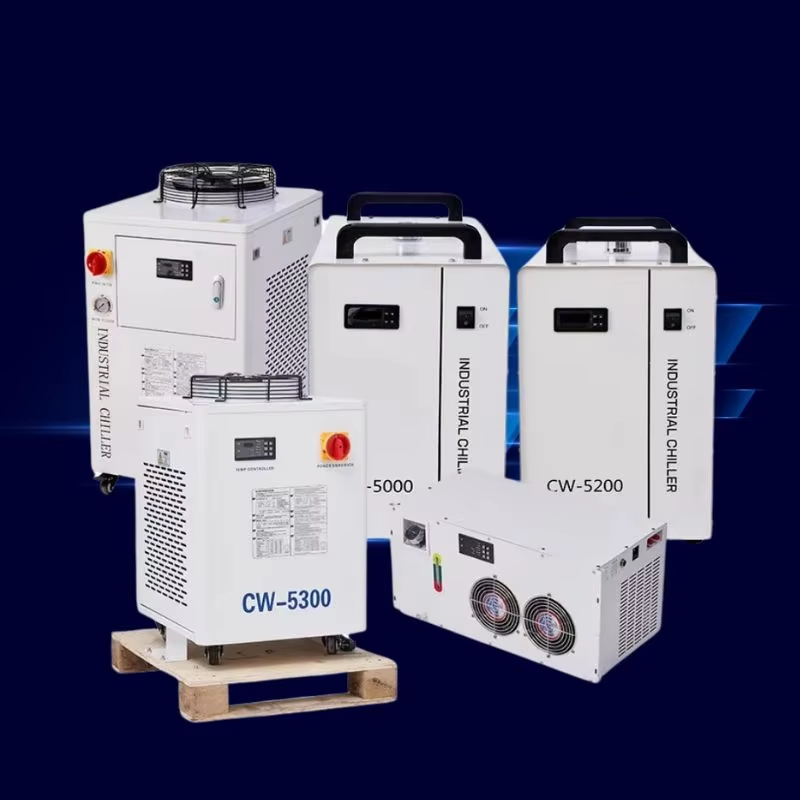
Rated vs. Sustained Cooling: Why 5200W Continuous 5200W Under CO2 Laser Load
Water chillers such as the CW 5200 often advertise their maximum cooling power based on lab tests conducted at around 25 degrees Celsius ambient temperature, with 12 liters per minute water flow and very small temperature differentials. But when running continuously during CO2 laser operations, things get complicated. The constant heat generated keeps the chiller from ever reaching those impressive 5200 watt figures listed in specifications. After hours of engraving work, heat builds up quicker than the system can handle, causing the compressor to cycle on and off while temperatures slowly creep upward. Take a standard 100 watt CO2 laser tube for instance. It actually produces somewhere between 120 to 150 watts worth of wasted heat. However, most shops operate in environments closer to 30 degrees Celsius with only half the recommended water flow rate. Under these more realistic conditions, the actual cooling capacity of the CW 5200 tends to fall short by about 15 to maybe even 20 percent. When this happens, problems start showing up pretty quickly. Just a few minutes where temperatures exceed what's safe for the laser tube leads to faster wear on electrodes and noticeable changes in how consistent the laser beam remains throughout production runs.
Key Performance Variables: Ambient Temperature, Water Flow Rate, and ΔT Impact
Three interdependent factors determine how much of its rated capacity the CW 5200 actually delivers during laser duty:
- Ambient Temperature: Heat rejection efficiency declines as ambient rises. For every 5°C increase above 25°C, capacity drops 10–15% due to reduced condenser effectiveness.
- Water Flow Rate: Below 8–10 LPM, flow restriction increases ΔT, forcing the compressor to run longer and less efficiently—raising internal temperatures and shortening component life.
- ΔT Stability: Precision thermal control (±0.3°C) isn’t just a spec—it’s a lifespan multiplier. Wider fluctuations directly accelerate material fatigue in laser tubes.
Matching CW 5200 Chiller Capacity to CO2 Laser Engraver Heat Loads
Heat Load Calculations for 50–100W CO2 Laser Tubes (Watts & BTU/hr)
Getting the right heat load calculation matters when picking out chillers for CO2 lasers. These laser tubes actually turn around 70 to 80 percent of their power into useful light, while the rest ends up as wasted heat that needs cooling. Most folks use something like this as a starting point: Take the laser's wattage rating and multiply it by between 1.2 and 1.5. This accounts for all those little losses that happen with the optics, power supply components, and how the beam gets delivered. Want to know the BTU per hour? Just take whatever number you get from that first calculation and multiply it by about 3.412. Keep in mind these are rough estimates though - actual requirements can vary based on specific equipment setups and environmental conditions.
Example: A 100W tube typically produces 120–150W of waste heat (410–510 BTU/hr). Real-world variables—including reflective material interactions, aging optics, and voltage fluctuations—can push this higher. That’s why industry best practices recommend oversizing chillers by at least 20% beyond calculated loads.
When Does a Laser Require the CW 5200? Thresholds, Duty Cycles, and Overheating Risks
Failure to meet cooling demands manifests as:
- Temperature fluctuations exceeding ±0.5°C—degrading beam focus and cutting repeatability
- Up to 34% reduction in tube service life (Ponemon 2023)
- Power droop during long jobs, requiring manual intervention or job restarts
The CW 5200 mitigates these issues through intelligent thermal management—not just raw cooling power.
Sizing and Deploying the CW 5200 Chiller for Optimal Laser Performance
Step-by-Step Sizing Formula: Laser Heat Load + 20% Safety Margin + System Losses
Proper sizing ensures the CW 5200 operates within its most efficient range—not constantly throttling or over-cycling. Use this validated formula:
- Laser Heat Load: 1.2–1.5 × tube wattage (e.g., 100W × 1.4 = 140W)
- Safety Margin (20%): Covers ambient spikes, workload surges, and aging components
- System Losses (10–15%): Accounts for tubing resistance, pump inefficiency, and heat gain in non-insulated loops
The 188W figure might seem low compared to the CW 5200's 5200W spec, but that's because it represents what happens during normal operation rather than those exaggerated lab tests we all know about. What really matters for this chiller is how it keeps temperature within just 0.3 degrees Celsius while pushing at least 2 gallons per minute through the system when things get busy. These aren't just marketing claims either. The consistent water flow combined with precise temperature management actually helps prolong tubing lifespan past the 10,000 hour mark, which makes a big difference in maintenance costs over time.
How the CW 5200 Chiller Extends CO2 Laser Tube Lifespan Through Precision Thermal Control
Stable ΔT (< ±0.3°C) and Its Proven Impact on Tube Longevity (10,000+ Hours)
When it comes to how long CO2 laser tubes last, thermal precision matters much more than simply having enough cooling capacity. The CW 5200 maintains temperature stability around ±0.3°C when running nonstop, which really cuts down on the kinds of stresses that cause these tubes to fail early. Looking at actual industry numbers shows something pretty impressive: tubes kept within this tight temperature range typically last well past 10,000 hours in service—that's about 40% longer than tubes subjected to temperature fluctuations of ±1°C or worse. Maintaining such stable temperatures stops several major problems from developing in the first place, including...
- Micro-fractures in fused silica tubing caused by repeated thermal expansion/contraction
- Degradation of the CO2:N2:He gas mixture due to uneven heating and localized hot spots
- Accelerated electrode erosion from inconsistent discharge conditions induced by temperature drift
By eliminating these stressors, the CW 5200 sustains beam quality, reduces unplanned downtime, and extends operational life to 2–3 years—even in high-duty-cycle production environments. That correlation between thermal control and longevity isn’t theoretical: it’s verified across thousands of installed units in manufacturing facilities worldwide.
FAQ
What is the cooling capacity of the CW 5200 chiller?
The CW 5200 chiller is advertised with a maximum cooling capacity of 5200 watts under ideal laboratory conditions. However, in real-world operations involving CO2 lasers, its effective cooling capacity may be reduced by 15-20% due to factors like ambient temperature and water flow rate.
Why does the CW 5200 chiller have reduced capacity in real-world operations?
The reduction in cooling capacity during real-world operations is primarily due to ambient conditions being less than ideal. Higher temperatures and lower water flow rates than recommended can negatively impact the chiller's performance.
How does ambient temperature affect the performance of the CW 5200?
Ambient temperature impacts the efficiency of heat rejection. As ambient temperature rises above 25°C, the chiller's cooling capacity can drop by 10–15% for every 5°C increase.
How important is ΔT stability for laser tube longevity?
ΔT stability is crucial because maintaining a tight thermal control around ±0.3°C prevents laser tube stress, prolonging its operational life up to 40% longer than tubes subjected to larger temperature fluctuations.